
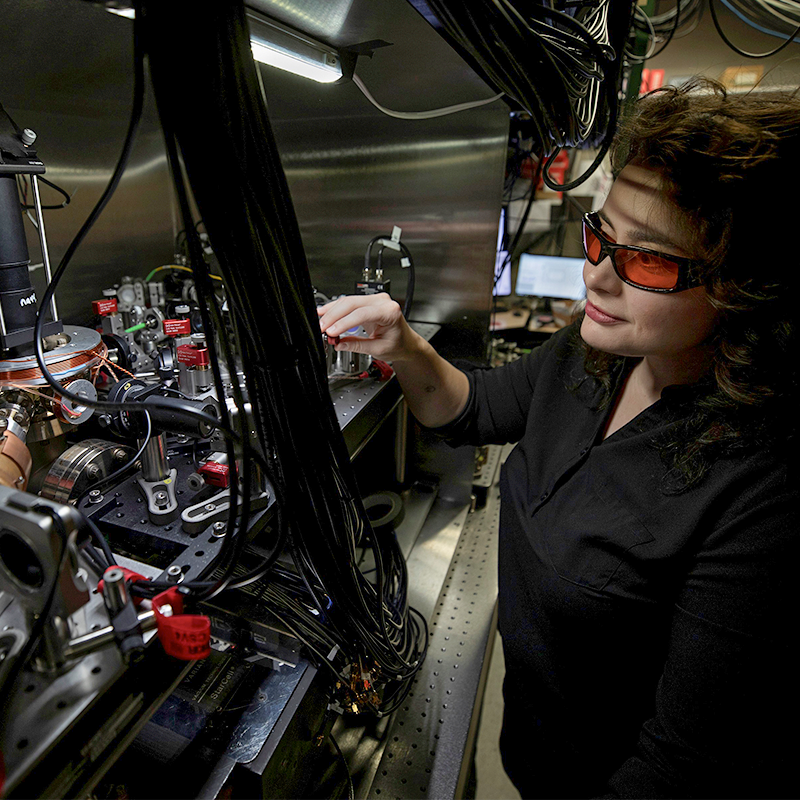
Research Overview: A Full-Stack Quantum Ecosystem
Georgia Tech’s quantum research ecosystem connects fundamental discovery to integrated systems and practical applications.
Across campus and the Georgia Tech Research Institute (GTRI), researchers advance quantum materials, devices, photonics, trapped ions, neutral atoms, defects, algorithms, software, sensing, fabrication, and applied systems engineering.
The quantum stack framework shows how shared infrastructure, testbeds, system-building capabilities, and workforce training programs support quantum building blocks, integrated quantum systems, and applications in computing, sensing, timing, networking, communication, and security.
This full-stack approach helps Georgia Tech and its partners move quantum ideas from discovery science toward deployable technologies, practical applications, and industry impact.
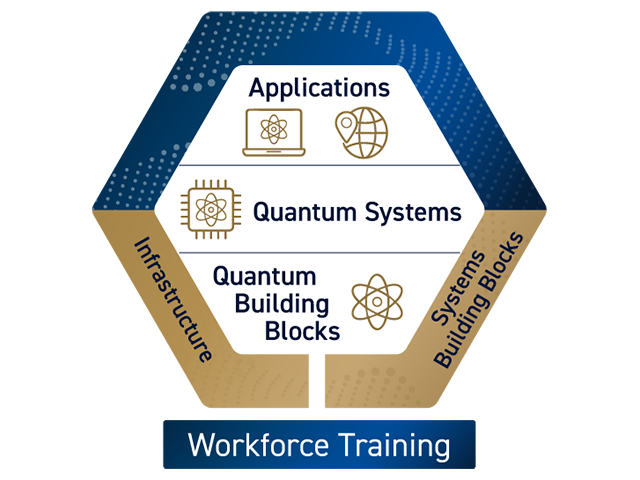
The quantum stack graphic above depicts the three levels of quantum research and development: quantum building blocks form the foundation for quantum systems, which enable real-world applications. Infrastructure and systems building blocks support development across these areas, while skilled workforce training provides the foundation for the entire quantum ecosystem.
Applications of Quantum Systems
At the top of the quantum stack, Georgia Tech focuses on applications where quantum technologies can create practical value for science, industry, government, and national security. These applications are not isolated from the rest of the stack; they are enabled by Georgia Tech’s strengths in quantum systems, building blocks, infrastructure, software, algorithms, and applied research.
Key Quantum Application Areas
Computation and Simulation
Applying quantum computing, hybrid quantum-classical workflows, algorithms, and simulation methods to problems in optimization, modeling, machine learning, quantum materials, chemistry, and scientific computing.
Positioning, Navigation, and Timing (PNT)
Developing atomic clocks, quantum sensors, and time-distribution systems for resilient positioning, navigation, and timing in environments where GPS may be unavailable, degraded, or contested.
Sensing and Communications
Quantum electromagnetic sensors can achieve unprecedented combinations of sensitivity, accuracy, and spatial resolution. This makes them useful in applications ranging from fundamental material science to measurements of biomagnetic signals to receiving widely tunable or low-frequency communications signals.
Network Security
Developing quantum-secure communications, quantum networking concepts, and cryptographic approaches that help address future cybersecurity challenges.
Quantum Systems
Quantum systems sit at the center of the stack. They translate quantum building blocks into functional platforms for computing, sensing, timing, communication, and networking. Georgia Tech’s approach is intentionally broad: rather than relying on a single hardware pathway, researchers across campus and GTRI advance multiple system concepts and connect them to applications where Georgia Tech can contribute distinctive strengths.
Major Quantum System Areas
Quantum Computers
Research spans quantum processors, system architectures, compiler and programming environments, hybrid quantum-classical workflows, algorithms, simulation, and hardware access strategies. Georgia Tech’s emphasis is on enabling technologies, software, algorithms, applications.

Quantum Sensors and Clocks
Georgia Tech develops sensing and timing platforms based on atomic, optical, solid-state, and materials-based approaches. These systems include atomic clocks and electromagnetic field sensors, and inertial sensors based on cold-atom and vapor-cell systems and solid-state defects.
Quantum Networks
Researchers are developing photonic, atomic, and integrated platforms that support quantum communication, secure information transfer, distributed quantum systems, and future quantum internet capabilities. Integrated photonics, atom-photon interfaces, optical systems, and network-aware architectures are key parts of this layer.
Quantum Building Blocks
Quantum building blocks are the physical platforms from which quantum systems are constructed. Georgia Tech pursues multiple building-block technologies, allowing the Institute to adapt as the field evolves and to connect different platforms to the applications where they are best suited.
Key Building Blocks
Photons
Building blocks for quantum communication, quantum networking, integrated photonics, optical control, and distributed quantum systems.
Optically Active Defects
Solid-state quantum defects, including color centers like Nitrogen-Vacancy (NV) centers and related platforms, support sensing, photonics, quantum control, and materials-enabled quantum science.
Quantum Materials
Materials whose electronic, magnetic, optical, or topological properties enable new quantum behaviors, devices, and systems. Georgia Tech’s strengths in materials science, quantum materials discovery, characterization, modeling, and simulation provide a foundation for future quantum platforms.
Trapped Ions
Trapped and laser cooled ions are a platform for quantum information processing and sensing. A longstanding strength of GTRI.
Neutral Atoms and Alkali Vapor Systems
Atoms in a thermal vapor, in a beam, or laser cooled and trapped can be used for sensing, timing, quantum information processing, and fundamental science.
System Building Blocks
Quantum systems also require cross-cutting engineering and computational capabilities, including software, programming environments, algorithms, multiphysics simulation, electronics, controls, integrated photonics, cryogenics, and advanced instrumentation. Systems engineers can help them all fit together into quantum devices and connect those devices into impactful real-world systems. These system-building capabilities connect foundational science to deployable technologies by making quantum devices more controllable, scalable, reliable, and application-ready.
Infrastructure and Testbeds
The quantum stack depends on a broad base of infrastructure and system-building capabilities. These capabilities allow researchers to design, fabricate, package, test, model, control, and integrate quantum technologies into usable systems.
Georgia Tech supports quantum research through cleanrooms, micro- and nanofabrication, manufacturing capabilities, packaging, characterization tools, testbeds, and access to commercial quantum computing platforms. These resources provide the experimental backbone for building and evaluating quantum materials, devices, sensors, photonic systems, and integrated platforms.
Workforce Training
Workforce development is a critical part of the quantum stack because advances in quantum technology depend on people with expertise across disciplines — from physics and materials science to engineering, computing, software, and systems integration. At Georgia Tech, education and hands-on research help connect these areas, preparing students and professionals to move quantum discoveries from the laboratory toward practical applications.
For the nation, building a skilled quantum workforce is essential to sustaining U.S. leadership and translating investments in quantum research into new technologies and industries. Developing talent across the full quantum stack helps ensure the U.S. has the scientists, engineers, developers, and technicians needed to advance quantum computing, sensing, communications, and other emerging applications while supporting long-term economic and national security priorities.