
Georgia Tech Quantum Applications Research Center
The Georgia Tech Quantum Applications Research Center (GT QuARC) serves as the coordination hub and external front door for Georgia Tech’s quantum ecosystem.
GT QuARC connects researchers, students, infrastructure, education programs, industry partners, government agencies, and the Georgia Tech Research Institute (GTRI) to help move quantum ideas from discovery science toward deployable systems and practical applications.
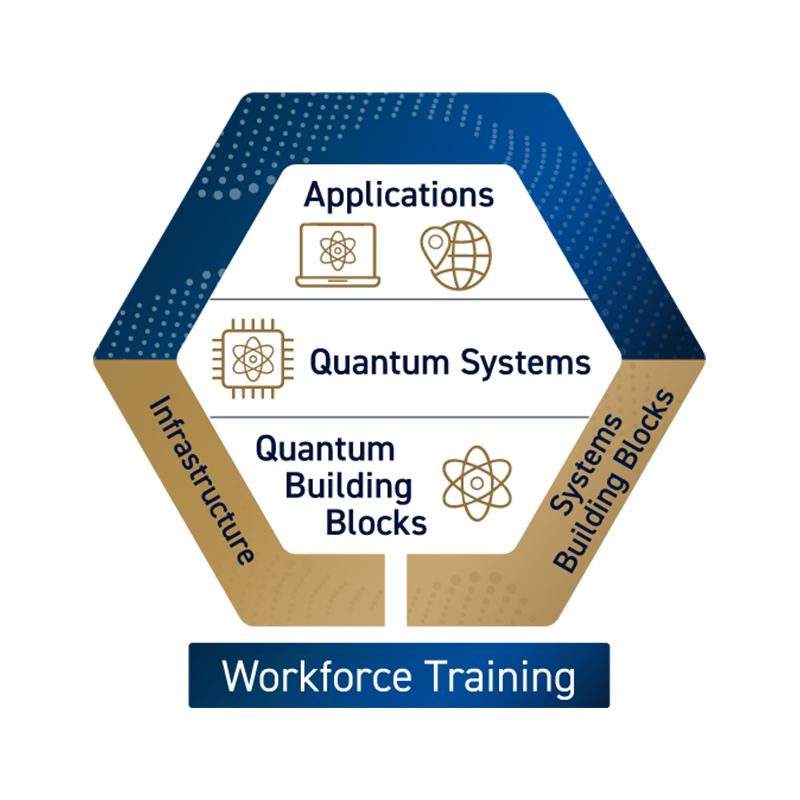
It is organized to support a full-stack approach. The center connects quantum building blocks, quantum systems, and quantum applications, while supporting interdisciplinary translation: system building blocks, shared infrastructure, and workforce development. This structure reflects Georgia Tech’s strengths across quantum materials, devices, photonics, sensing, algorithms, software, fabrication, testbeds, applied systems engineering, and GTRI’s mission-driven research.
GT QuARC does not replace existing quantum activities across campus. Instead, it helps coordinate them, make them more visible, and connect them to external partnerships, shared facilities, proposal opportunities, and hands-on training.
Focus Areas

Quantum Building Blocks
Fundamental and enabling technologies including quantum materials, defects, spins, photonics, atomic and molecular platforms, quantum measurement, theory, modeling, controls, and benchmarking.
Quantum Systems
Integrated platforms for quantum computing, sensing, timing, networking, and communication, including fabrication, packaging, cryogenic systems, vapor cells, photonic devices, control electronics, testbeds, and systems engineering.
Quantum Applications
Use cases and benchmarks in quantum computing, hybrid quantum-classical workflows, sensing, secure communications, post-quantum security, materials and chemistry simulation, and mission- or industry-driven problems.

Infrastructure and Access
Shared tools, testbeds, fabrication and characterization capabilities, external quantum computing platform access, and coordination with IMS, GTRI, future NQNI efforts, and cleanroom/quantum applications investments.
Workforce and Partnerships
Hands-on training, graduate fellowships, professional education, internships, capstone-style projects, external advisory input, and partnerships with industry, national laboratories, government agencies, and regional stakeholders.
Contacts
•••

Martin Mourigal
Co-Director, Quantum Applications Research Center
Dunn Family Professor, School of Physics
Robert Wyllie
Co-Director, Quantum Applications Research Center
Division Chief, Quantum System Division, CIPHER
•••